

Two Words, One Technology — Or Are They?
Walk into any defence exhibition and you will hear both terms used in the same breath. A procurement officer will ask about "drone capability." An engineer will respond with "UAV specifications." A general will reference "unmanned systems." All three are pointing at the same aircraft, yet the language diverges for a reason.
Understanding the difference between a UAV and a drone is not a matter of pedantry. In military applications specifically, the terminology shapes how systems are classified, regulated, budgeted, and deployed. Getting it right matters — both for the people writing requirements documents and for the engineers building the hardware.
Definitions: Where the Terms Come From
UAV stands for Unmanned Aerial Vehicle. It is the formal term used by NATO, military doctrine, and most national defence standards. More recently, the umbrella term UAS (Unmanned Aerial System) has gained preference in professional circles because it acknowledges that the aircraft itself is only part of the picture — the ground control station, the communication link, and the operator are all part of the system.
Drone is a colloquial term with a longer history than most people realise. It was first used in the 1930s to describe radio-controlled target aircraft — specifically, the British de Havilland Queen Bee — where the buzzing of the engine inspired the name. For decades it was a niche term used in testing and target practice contexts.
The word re-entered mainstream usage in the 2000s as consumer quadcopters became widely available, and the media adopted it as a catch-all for any remotely piloted aircraft. Today "drone" is understood by general audiences worldwide, while "UAV" remains the standard in technical, military, and regulatory documentation.
The Practical Distinction in Military Context
In a military context, the distinction matters across several dimensions.
Classification and Doctrine
NATO's STANAG 4586 and equivalent national standards use UAV terminology throughout. Military platforms are classified by category — ranging from Class I (under 150 kg) to Class III (over 600 kg) — and these classifications carry specific airspace, training, and maintenance requirements. When a military unit submits a capability requirement or a defence contractor responds to a tender, the document will always use UAV or UAS, not "drone."
Using the word drone in a formal military setting can create ambiguity about whether the system in question is a consumer-grade device, a commercial platform, or a purpose-built military system. The terminology signals the level of capability, ruggedisation, and accountability expected.
Levels of Autonomy
Another distinction that matters in military contexts is the degree of autonomy. Historically, UAV implied a vehicle that was remotely piloted — a human operator controlled it from a ground station. Modern systems, however, operate across a spectrum.
- Remotely Piloted Aircraft (RPA): A human operator has continuous positive control. Every manoeuvre is commanded.
- Semi-autonomous UAV: The aircraft can follow a pre-programmed route, hold altitude, or return to base without constant input, but a human authorises any engagement or deviation.
- Autonomous UAV: The system can make decisions based on sensor inputs and onboard logic without real-time human input. This category is subject to significant legal and ethical debate within NATO and international law frameworks.
The word "drone" carries none of this nuance. A consumer drone and an autonomous loitering munition are both "drones" in casual language — but they represent entirely different capability and regulatory categories.
Loitering Munitions: A Special Case
One category deserves specific attention: loitering munitions. These are systems that fly to a target area, orbit while searching for a target, and then engage by flying into the target — effectively functioning as both a sensor and a precision-guided weapon.
Loitering munitions are technically UAVs (they are unmanned, aerial, and vehicles), but they occupy a distinct doctrinal space. They are not reusable, they carry warheads, and their rules of engagement are governed by a separate legal framework from ISR (Intelligence, Surveillance, Reconnaissance) UAVs. Some nations classify them separately as "kamikaze drones" or "suicide drones" in media reporting — terms that, again, are never used in operational military documentation.
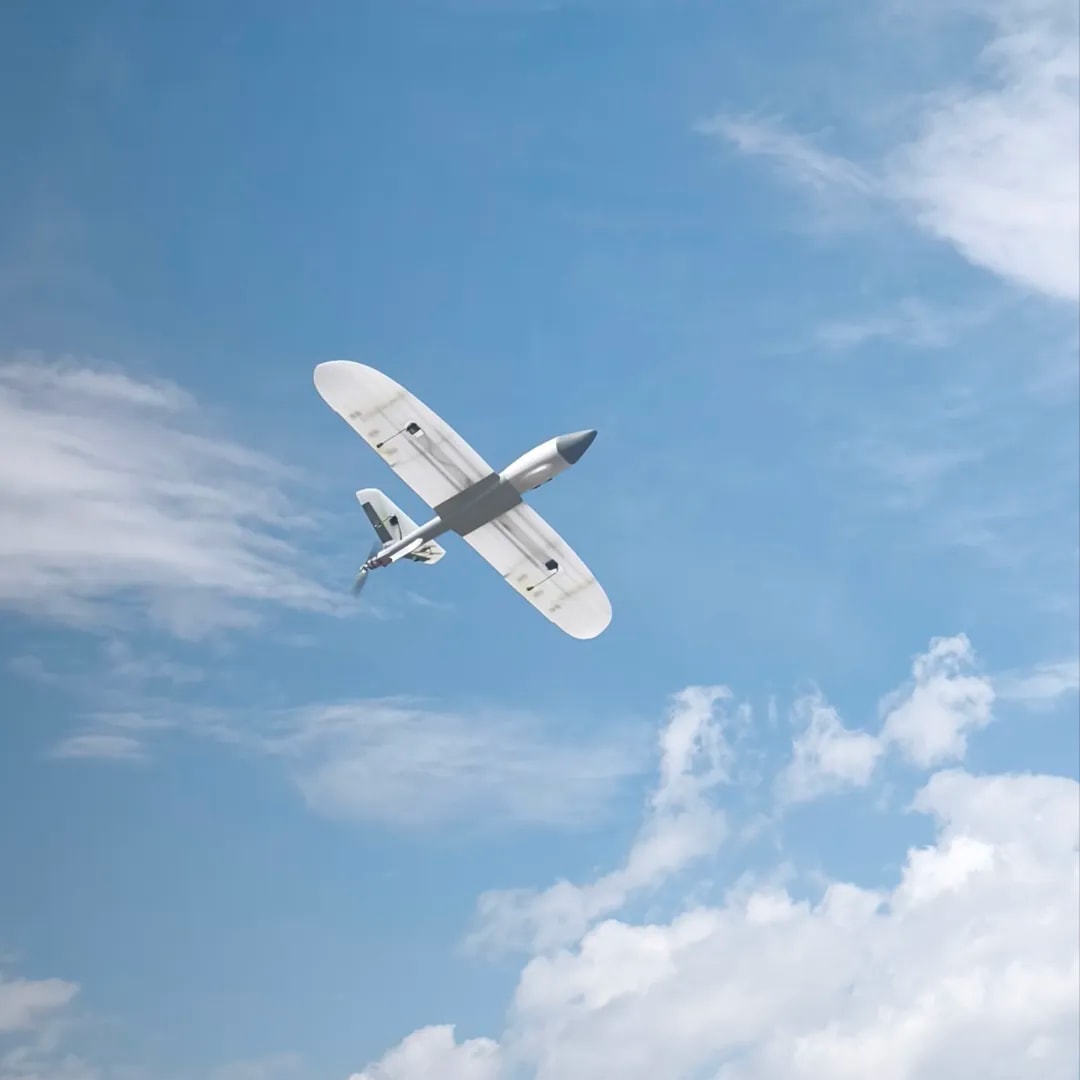
Our IRYDA+ is a fixed-wing loitering munition UAV, designed specifically for this role. Precision engagement, extended loiter time, and operator-confirmed engagement are the defining characteristics of this platform — capabilities that the word "drone" alone does not convey.
Why Both Terms Coexist
The coexistence of both terms is not a problem to be solved — it is a reflection of different audiences and contexts.
For procurement and operations, UAV/UAS is the correct terminology. It connects to doctrinal frameworks, maintenance programmes, airworthiness standards, and rules of engagement. When Shark Aviation Dynamics submits technical documentation, integrates with NATO-compatible ground control systems, or specifies communication standards, we operate within the UAV/UAS framework.
For broader communication — press releases, general awareness, public affairs — the word drone is both accurate and understood. There is no dishonesty in using it. It simply signals a different audience.
The risk comes when the terms are mixed carelessly in operational documents, or when the vagueness of "drone" is used to obscure the capability level of a system during procurement. A request for a "surveillance drone" that is fulfilled with a consumer quadcopter instead of a military-grade ISR UAV is an expensive and potentially dangerous outcome of imprecise language.
Military UAV Categories at a Glance
To ground this discussion practically, here is how military platforms are typically organised.
MALE (Medium Altitude Long Endurance): Large, long-range platforms capable of carrying heavy sensor payloads and operating for 24 hours or more at altitude. Typically used for persistent ISR and strike. Examples include the Predator and Reaper class.
MALE-equivalent tactical UAVs: Smaller than MALE but designed for sustained tactical ISR over an operational area. Often operated at the brigade or battalion level.
TUAV (Tactical UAV): Man-portable or vehicle-launched systems used for short-range reconnaissance at the company or platoon level. Rapid deployment and simplicity of operation are the defining requirements.
Loitering munitions: As described above. Single-use, precision-guided, with an extended search-and-engage capability.
Micro-UAV and nano-UAV: Small systems, often hand-launched, used for close-range reconnaissance in urban or denied environments.
The Shark Tiger fits within the TUAV-to-MALE bridge — a compact, high-performance system capable of sustained operations in electromagnetically and environmentally challenging conditions. The IRYDA+ and IRYDA+ X1 operate in the loitering munition category.
The Language We Use at Shark Aviation Dynamics
At Shark Aviation Dynamics, we use both terms deliberately.
In our technical documentation, integration guides, and NATO-facing materials, we use UAV and UAS. In general communications, blog posts, and outreach to audiences who are learning about unmanned systems for the first time, we use drone — because it is the word people search for and the word that gets the conversation started.
What we never do is allow vague language to obscure capability. When we say "military drone," we mean a platform designed and certified to military requirements — with encrypted communications, hardened electronics, and ruggedised airframes built for operational environments, not consumer use cases.
If you are evaluating unmanned platforms for a serious application and want to discuss capability, requirements, or integration, we are ready for that conversation.
Reach us through the contact page.