

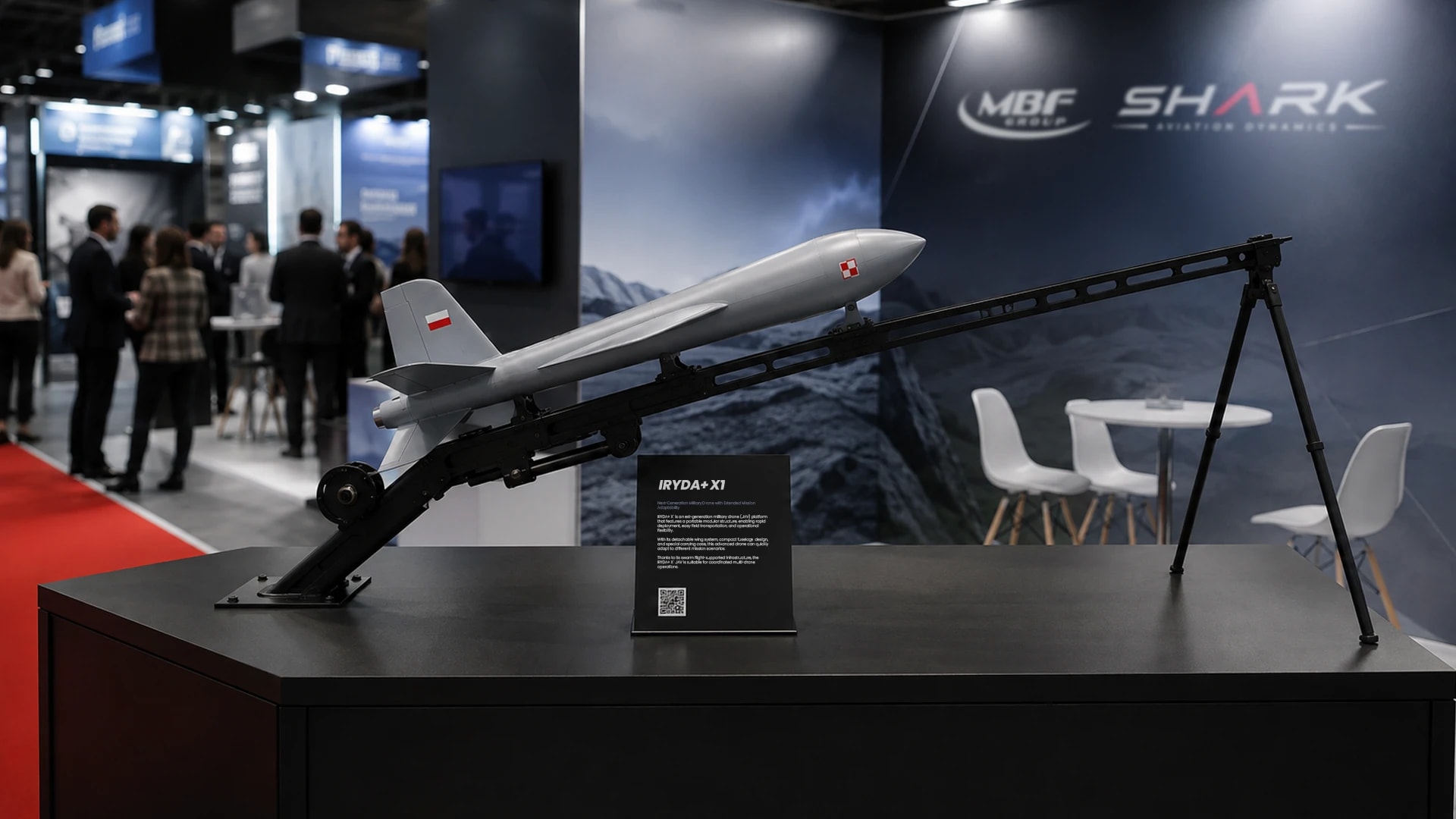
IRYDA+ X1 Heads to Kielce
The IRYDA+ X1 system will make its first public presentation in Poland and Europe on 8 September 2026 during the 34th International Defence Industry Exhibition, MSPO, in Kielce.
The presentation will take place on the opening day of the exhibition as part of a nationwide scientific conference dedicated to dual-use technologies, national security, and the development of industrial and technological capabilities. Representatives of academia, research institutions, the military, public administration, and the defence industry are expected to take part.
For MBF Group S.A. and Shark Aviation Dynamics, the event is the next step in moving the military drone (UAV) programme from controlled technical demonstrations toward wider professional evaluation. The presentation will introduce the system, summarize verified results, and explain the engineering and industrial roadmap for its continued development in Poland and Europe.
Why MSPO Matters
MSPO is one of Europe's most important defence-industry meeting points. It brings technology developers into direct contact with armed forces, government institutions, integrators, manufacturers, research organizations, and international partners. That makes it a demanding but appropriate environment for the European public debut of IRYDA+ X1.
A specialist audience is likely to ask different questions from viewers at a general technology event. They will want to understand which capabilities have been demonstrated, which remain in development, how the system can integrate with existing command structures, and what support will be available throughout its lifecycle.
The MSPO presentation is being prepared with that distinction in mind. It will separate verified results from planned functions and qualification work. This is especially important in unmanned systems, where terms such as autonomy, artificial intelligence, and swarm operation can be used too broadly. Professional users need a clear account of what the current platform has achieved and what the next test phase is intended to prove.
The event will also create an opportunity to discuss the system with organizations that could participate in integration, testing, service, training, and production. Those conversations are central to turning a successful prototype programme into a sustainable operational and industrial capability.
A System Already Tested in Türkiye
IRYDA+ X1 will arrive at MSPO with results from its first public operational demonstration, held in Konya, Türkiye, on 19 July 2026. That Phase I event brought five prototype platforms into a coordinated test environment and evaluated autonomous flight, multi-aircraft control, flight performance, precision scenarios, and recovery functions.
One prepared scenario included an autonomous mission profile of approximately 26 km. Two UAVs were managed simultaneously by one operator using a single Ground Control Station. The demonstration recorded approximately 18 minutes of flight, a cruising speed of about 99 km/h, and a maximum indicated speed of 146 km/h.
Phase I also confirmed that a mission could be interrupted, payload activation could be cancelled, and an aircraft could transition to autonomous landing and recovery while maintaining its connection. These functions demonstrate that automation and operator authority can coexist within the same control architecture.
The Konya figures describe a specific test configuration and mission. Wider programme materials have reported operation beyond 20 km, completion of a 30+ km flight-test campaign, endurance of up to 60 minutes, and continued development toward coordinated operation by larger groups of aircraft. MSPO will provide a forum for explaining how those programme-level claims relate to demonstrated test results and the next configuration roadmap.
What Visitors Will Learn About IRYDA+ X1
IRYDA+ X1 is a fixed-wing, modular UAV designed around portability, autonomous mission execution, and coordinated multi-aircraft operation. Its published airframe dimensions include a 1,320 mm wingspan and an 850 mm fuselage. Detachable wings and a dedicated transport case allow the platform to be moved and assembled with a limited logistical footprint.
The aircraft forms one part of a broader system. Mission planning, telemetry, operator controls, and multi-UAV coordination are brought together through the GCS. The open architecture is intended to support additional communications, payloads, telemetry functions, and AI-assisted capabilities without replacing the entire platform.
The presentation will cover:
-
the system concept and the operational needs it is intended to address;
-
results from development testing and the Konya Phase I demonstration;
-
the “one operator, multiple UAVs, one mission” control architecture;
-
portability, modular construction, and field deployment;
-
the distinction between demonstrated functions and capabilities still being developed;
-
potential applications and the next stages of work in Poland and Europe;
-
opportunities for cooperation with users, integrators, industry, and research institutions.
The goal is not to present a mock-up or a concept supported only by slides. The partners will present a functioning system that has completed an operational demonstration and generated data for the next development phase.
A Conditional Swarm Flight
The programme partners intend to explore the possibility of presenting IRYDA+ X1 in flight over the exhibition grounds in a swarm configuration. Any such flight remains conditional on receiving the required organizational and aviation approvals.
That condition is more than a formal caveat. Public flight demonstrations require airspace coordination, risk assessment, event planning, and compliance with the directions of the relevant authorities. The conference presentation and programme participation do not depend on the flight being approved.
If authorization is granted, the flight would offer visitors a visible demonstration of the multi-aircraft concept. If it is not, the technical presentation will still provide the verified Konya results, system architecture, and development evidence needed for meaningful professional discussions.
From Phase I to Phase II
MSPO comes at the transition between the completed first phase of technical verification and the programme's next stage in Poland. Phase I confirmed basic assumptions and created a documented engineering baseline. Phase II is expected to extend testing, integration, and industrial participation.
Several areas remain important for continued work. The partners must evaluate larger multi-aircraft configurations, communications performance, additional payloads, software functions, repeatability, and customer-specific qualification requirements. Each step will need clearly defined test conditions and evidence.
The open architecture is intended to make that development practical. New functions can be integrated around a common aircraft and control environment, while lessons from each flight feed into later configurations. This iterative approach avoids treating the first successful demonstration as a finished product.
MSPO provides the right setting to discuss those next steps with potential users. Their requirements can help shape priorities for range, endurance, communications, payload integration, training, support, and interoperability. Early technical dialogue is essential if the system is to develop around real operational needs rather than assumptions.
Building Capability in Poland
The programme has an industrial objective as well as an engineering one. MBF Group and Shark Aviation Dynamics want to examine the creation of Polish capabilities for UAV integration, service, training, development, and production.
As of 10 August, initial dialogue was under way with more than ten local governments whose regions may meet the basic requirements for a future unmanned-systems hub. No location has been selected. The evaluation is expected to consider aviation infrastructure, access to testing areas, technical and academic support, logistics, workforce, local suppliers, and capacity for expansion.
The ambition extends beyond final assembly. A sustainable programme requires trained specialists, engineering knowledge, software and system-integration competence, maintenance capability, and a supply chain able to support continued development. The experience gained in Konya can inform that process, but translating it into Polish capacity will require structured knowledge transfer, investment, and long-term cooperation.
MSPO will allow the partners to begin those discussions with potential industrial participants and public institutions in one place. It is an opportunity to identify organizations that can contribute real capabilities rather than simply attach their names to the programme.
Polish–Turkish Engineering Cooperation
IRYDA+ X1 has developed through cooperation between teams with complementary roles. Shark Aviation's engineers have worked across airframe development, flight control, mission software, telemetry, integration, planning, and technical trials. MBF Group has supported the programme's Polish industrial, commercial, and institutional development.
The Konya demonstration showed how that cooperation works in practice. MSPO will bring the results into a European defence-industry setting and open the programme to a broader group of evaluators and potential partners.
This international model matters because an unmanned system is not sustained by an airframe alone. It needs software, communications, testing, training, maintenance, manufacturing, and continuing engineering support. Combining experience across those areas can shorten the path from prototypes to dependable fielded capability—provided that each stage remains grounded in measured results.
The Next Public Milestone
The 8 September presentation will not be the conclusion of the IRYDA+ X1 programme. It is the next public checkpoint in a longer process of technical verification, integration, and industrial development.
Visitors should expect a clear account of what has already been demonstrated, what the programme is building next, and where cooperation is needed. That transparency is particularly important for defence buyers and integrators assessing whether a platform can mature into a supported operational system.
IRYDA+ X1 comes to MSPO with physical prototypes, completed test scenarios, measured Phase I results, and a roadmap for further work. The Kielce presentation will give Poland's defence, research, and industrial communities their first broad opportunity to examine that progress directly.
To arrange a discussion about IRYDA+ X1 during MSPO 2026 or explore integration and partnership opportunities, contact Shark Aviation Dynamics.