

A Joint Programme Takes Flight in Konya
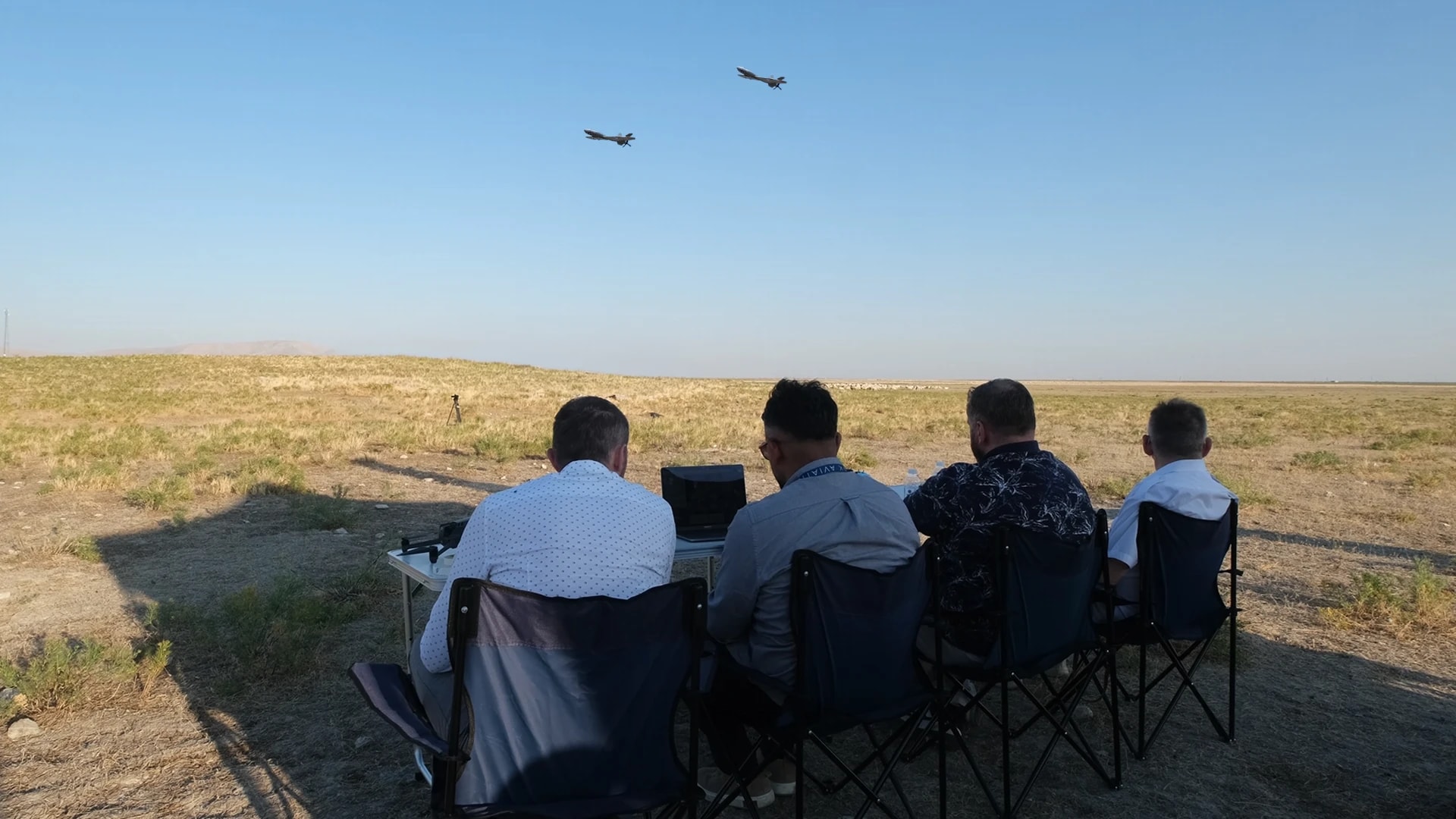
On 19 July 2026, MBF Group S.A. and Shark Aviation Dynamics presented the IRYDA+ X1 system in Konya, Türkiye. The event marked the first public operational demonstration of the programme and brought months of engineering, integration, and flight testing into one coordinated test environment.
The purpose was broader than displaying an aircraft. The team set out to demonstrate how the military drone (UAV), mission software, communications, and Ground Control Station work together. Prepared scenarios covered flight performance, autonomous mission execution, precision, and the coordination of multiple platforms.
The demonstration also represented a milestone in Polish–Turkish industrial cooperation. Shark Aviation's engineering team was responsible for the airframe, flight control, mission planning, software, telemetry, system integration, and technical trials. MBF Group contributed the Polish commercial, industrial, and programme-development perspective. Konya gave both partners an opportunity to validate not only the technology, but also the working model behind its continued development.
What Phase I Was Designed to Verify
An operational demonstration is valuable when it answers specific engineering questions. For IRYDA+ X1, Phase I focused on whether the prototypes could execute prepared mission profiles, whether more than one aircraft could be supervised through a common control environment, and whether the system could preserve operator authority throughout the mission.
Five prototype platforms participated in the prepared scenarios. They represented an evolving test configuration rather than a frozen production model, allowing the engineering team to collect data and identify improvements for subsequent stages.
The demonstration examined several connected capabilities:
-
autonomous execution of a planned flight profile;
-
simultaneous control of multiple UAVs through one GCS;
-
communication between the aircraft and operator during the mission;
-
recorded flight performance under the demonstration conditions;
-
mission interruption, cancellation, and recovery procedures;
-
coordinated scenarios involving flight precision and multi-aircraft operation.
All planned scenarios were reported as completed successfully. The detailed Phase I results were then reviewed jointly so that later programme communications could distinguish confirmed measurements from functions that still require further testing or qualification.
An Autonomous Mission of Approximately 26 Kilometres
One of the principal scenarios was an autonomous mission profile covering approximately 26 km. The result demonstrated that the aircraft could follow the assigned route and mission logic while remaining connected to the control environment.
That distinction matters. Autonomous flight is not simply the ability to hold altitude or follow a straight line. An operational system must combine navigation, mission sequencing, telemetry, and operator oversight. It must also respond predictably when the mission is changed or stopped.
The Konya profile created a measurable baseline for those functions. It did not attempt to prove every future capability of the programme. Instead, it established that the current prototypes could execute a representative mission and provide the data needed to refine subsequent configurations.
The approximately 26 km demonstration should also be read alongside the wider development campaign. Programme materials have reported operation beyond 20 km and a completed 30+ km flight-test campaign. These figures concern different flights and conditions; the Konya number identifies the prepared Phase I mission rather than the absolute limit of the platform.
Two UAVs, One Operator, One Ground Station
The most important architectural result was the simultaneous management of two platforms by one operator using one ground control station. This validated the foundation of the programme's “one operator, multiple UAVs, one mission” approach.
Coordinated UAV operation can reduce the workload created by treating every aircraft as an independent system. Mission planning, telemetry, task status, and intervention controls can be brought into a shared environment. The operator supervises the mission and retains decision-making authority while the system handles repeatable flight-control and coordination tasks.
Two aircraft are not the final ambition of the swarm architecture. Earlier programme materials have described a scalable environment intended to support larger groups of platforms. The Konya result is nevertheless significant because it moves the concept from design intent to demonstrated multi-aircraft control.
Future stages will need to evaluate how the architecture performs as more aircraft, payloads, communications demands, and mission variables are introduced. Phase I provides the working baseline for that growth.
Recorded Flight Performance
The Phase I report confirmed approximately 18 minutes of flight during the demonstration scenario. It also recorded a cruising speed of about 99 km/h and a maximum indicated speed of 146 km/h.
These measurements describe the aircraft and configuration used in Konya. They should not be confused with programme-level endurance or range statements, which may reflect different mission profiles, payloads, speeds, and operating conditions. Published materials have described endurance of up to 60 minutes, while the Konya scenario was a shorter, prepared demonstration with multiple objectives.
Maintaining that distinction is important for professional evaluation. Endurance, range, speed, and payload are interdependent. A customer assessment must consider the exact airframe configuration, mission profile, communications package, environmental conditions, and reserve requirements rather than selecting the highest value from separate development tests.
For the programme, the value of the Konya figures is their role as a documented baseline. They give engineers measured data for further optimization and give potential users a clearer picture of what was achieved under a defined demonstration scenario.
Precision Without Confusing Separate Trials
The Konya programme included scenarios covering hit accuracy, and the partners reported that the planned tests concluded successfully. Separate field trials conducted during the wider development campaign had previously reported approximately one-metre guidance accuracy and a controlled airburst around five metres above ground, with effects across an area roughly 30 metres in diameter.
Those earlier measurements should not be attributed automatically to the Konya event. They were part of the broader validation effort and helped prepare the system for its public demonstration. Konya confirmed the completion of its own planned scenarios; the programme's technical record combines results from multiple tests, each with its own conditions and objectives.
This evidence-based approach is essential for defence technology. A demonstration can show that a system works in a particular scenario, but repeatability, qualification, and customer acceptance require further trials. IRYDA+ X1 has moved beyond concept imagery and isolated prototypes, but development continues.
Mission Abort and Aircraft Recovery
Phase I also confirmed functions that are less dramatic than speed or precision but equally important in practice. The operator could interrupt a mission, cancel payload activation, and direct the aircraft into an autonomous landing and recovery sequence while maintaining the connection.
An operator may need to stop a mission because conditions have changed, authorization has been withdrawn, the assigned objective is no longer valid, or the aircraft should be preserved for another task. A system that provides only a path forward, without a controlled way to disengage, creates operational and economic limitations.
Recovery capability also supports the development process itself. Prototype aircraft can return with recorded data, be inspected, and fly again. That accelerates learning and reduces the cost of validating software, communications, navigation, and multi-aircraft functions.
Most importantly, the result reinforces human authority. Automation assists with flight and coordination, but the operator retains the ability to intervene and end the mission.
More Than a Flight Display
The Konya visit brought together engineering, operational, institutional, academic, and business perspectives. Alongside the demonstration, the partners held meetings intended to explore future technical collaboration and the wider industrial environment around the programme.
Initial agreements were signed at InnoPark during the visit, while detailed commercial and technical terms remained subject to formal documentation and subsequent disclosure. The significance of those meetings should therefore be described carefully: they created routes for further cooperation, but they did not replace the engineering work or guarantee future orders.
This measured interpretation is consistent with the purpose of Phase I. The demonstration was a gateway to the next development stage, not the end of the programme. Its results support further discussions with users, integrators, research partners, and organizations interested in building unmanned-system capabilities.
What the Results Mean
Konya established several facts about the current IRYDA+ X1 programme. Physical prototypes executed the planned scenarios. An autonomous mission profile was completed. Two UAVs were supervised by one operator through one GCS. Flight-performance data was recorded. Mission interruption and recovery functions were demonstrated.
Together, those results show that IRYDA+ X1 is operating as a system, not merely as an airframe. The programme now has evidence that can guide software development, platform refinement, integration planning, and future evaluation.
The demonstration also showed the practical value of the partnership behind it. Polish and Turkish teams combined programme development, aviation engineering, operational experience, and industrial planning in a shared test environment. That working relationship will be essential as the system advances toward larger demonstrations, additional configurations, and customer-specific requirements.
Phase I does not remove the need for continued testing. Swarm scaling, communications resilience, payload integration, qualification, and repeatability remain areas for further work. What Konya provides is a credible starting point: measured results, documented scenarios, and a system ready for its next engineering questions.
Organizations interested in IRYDA+ X1 demonstrations, integration, or technical discussions can contact Shark Aviation Dynamics.