

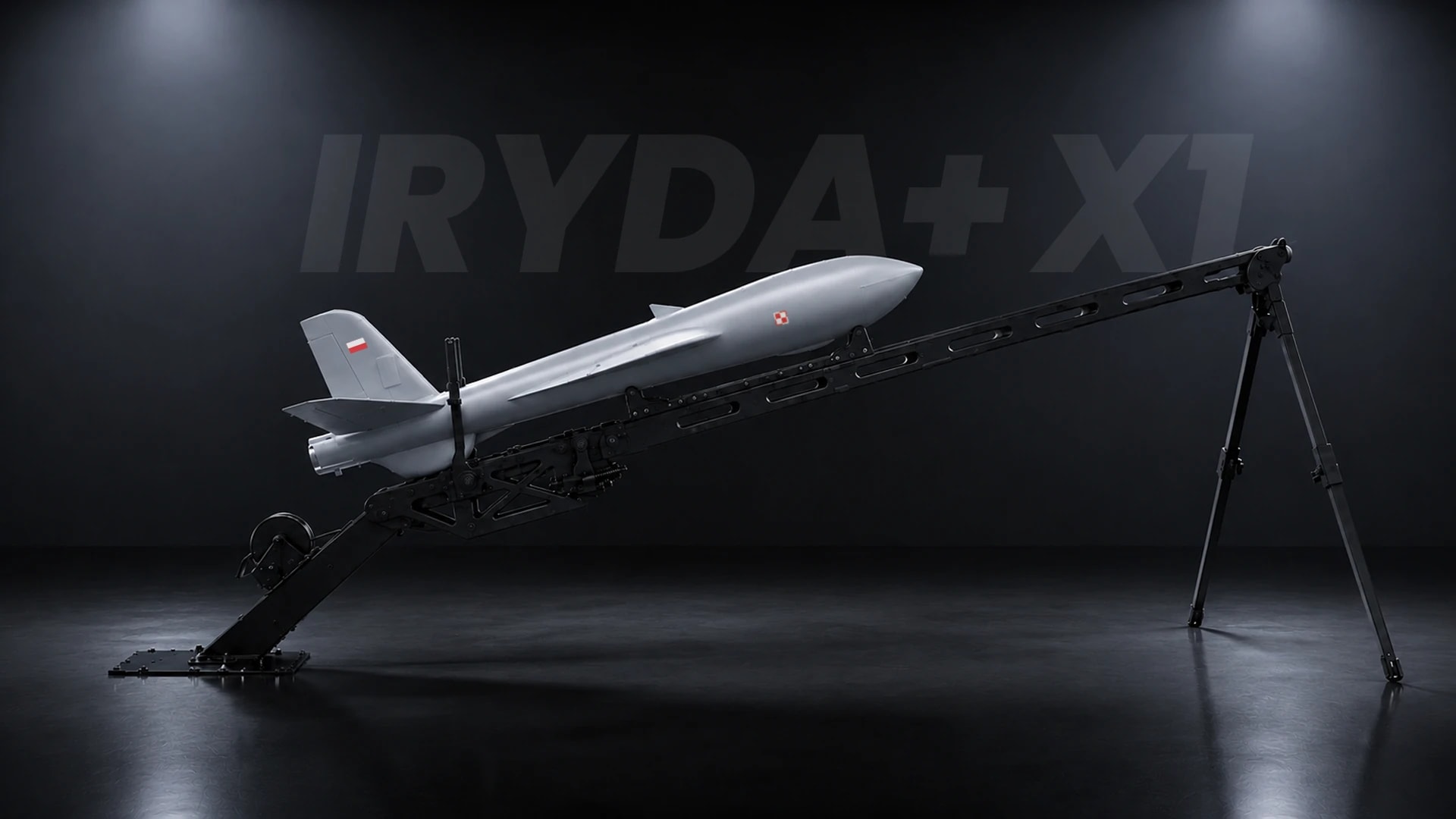
What Is IRYDA+ X1?
IRYDA+ X1 is a fixed-wing military drone (UAV) developed as a mobile, modular platform for autonomous missions and coordinated multi-aircraft operations. It brings the aircraft, mission software, communications, and ground control functions together as one operational system rather than treating the airframe as an isolated product.
The programme is being advanced through cooperation between MBF Group S.A. and Shark Aviation Dynamics. It combines Polish industrial and commercial ambitions with Turkish aviation engineering experience, creating a shared path from design and testing to demonstrations, integration, and future production capabilities in Poland.
At the centre of the concept is a simple operating principle: one operator, multiple UAVs, one mission. IRYDA+ X1 is designed so that several aircraft can exchange data, maintain coordinated flight, and execute assigned tasks through a common Ground Control Station (GCS). This architecture makes the system more than a single drone. It is the first operational building block of the wider IRYDA+ programme.
Built for Mobility and Rapid Deployment
Modern unmanned systems are judged not only by their performance in flight, but also by how quickly they can be transported, assembled, launched, and supported in the field. A capable aircraft that requires extensive infrastructure creates a logistical burden before its mission even begins.
IRYDA+ X1 addresses that problem with a compact, detachable airframe. Published platform dimensions include a wingspan of 1,320 mm and a fuselage length of 850 mm. The wings and fuselage can be separated for transport in a dedicated case and assembled close to the operating area. This reduces the space needed for transport and allows the system to be prepared without the facilities associated with much larger unmanned aircraft.
Portability also supports operational flexibility. Teams can relocate the system, establish a new launch position, and adapt to changing mission requirements with a smaller logistical footprint. For institutional users, that can matter as much as maximum range or speed: mobility affects survivability, deployment time, personnel requirements, and the number of systems that can be positioned across an operating area.
One Operator, Multiple UAVs
The defining feature of IRYDA+ X1 is its swarm-supported architecture. In this context, a swarm is not simply several drones flying near one another. It requires the aircraft and control system to share mission information, coordinate their movement, and operate as parts of a common plan.
The architecture is intended to support:
-
mission planning for multiple aircraft from one control environment;
-
real-time data exchange and mission synchronization between UAVs;
-
autonomous formation and coordinated flight functions;
-
adaptive task execution as mission conditions change;
-
expansion through additional software functions, payloads, and AI-supported capabilities.
This approach changes the operator's role. Instead of manually piloting every movement of one aircraft, the operator supervises the mission, assigns tasks, and retains authority over key decisions. Automation handles repeatable flight-control and coordination functions while the human operator remains responsible for mission command.
Phase I testing later confirmed a practical foundation for that model. Five prototype platforms took part in prepared scenarios, and two UAVs were managed simultaneously by one operator through a single ground control station. That result is narrower than the programme's full swarm ambition, but it is important because it demonstrates a working control architecture rather than a concept shown only in simulations.
Open Architecture for Continued Development
Unmanned technology changes quickly. Communications, sensors, navigation methods, mission software, and artificial-intelligence tools develop on different schedules. A closed system can become obsolete when one of those layers can no longer meet operational requirements.
IRYDA+ X1 therefore uses an open, modular architecture intended to accommodate new functions without redesigning the entire aircraft. Published development directions include advanced telemetry, additional payloads, AI-supported mission logic, and operation where satellite-navigation signals are limited or unavailable.
Open architecture is important for another reason: different users rarely have identical requirements. Border-security organizations, infrastructure operators, military units, training centres, and system integrators may need different communications, data products, or mission workflows. A common platform with configurable software and integration points offers a more sustainable route than creating a separate aircraft for every use case.
That does not mean every planned function is already qualified. The programme separates demonstrated capabilities from features that still require testing, integration, or formal evaluation. This distinction is essential for defence buyers, who must be able to tell the difference between a development roadmap and a capability supported by test evidence.
Published Capabilities and Demonstrated Results
IRYDA+ X1 has progressed through successive prototypes and test campaigns, so published figures describe different configurations and test conditions rather than one frozen production specification.
Programme materials have described an endurance of up to 60 minutes, operation beyond 20 km, a completed 30+ km flight-test campaign, and an approximately 311-gram (11-ounce) payload capacity. Materials have also referred to mission effects at ranges of 30–40 km. These are programme-level capability statements and should be assessed against the final configuration selected for a customer and mission.
The Phase I technical verification in Konya provided a more specific operational snapshot. Five prototypes executed prepared scenarios that included an autonomous mission profile of approximately 26 km. The demonstration recorded around 18 minutes of flight, a cruising speed of approximately 99 km/h, and a maximum indicated speed of 146 km/h.
Earlier development communications cited lower cruise figures while later Phase I reporting recorded the higher speeds above. Because the reports concern different stages and operating conditions, they should not be combined into a single definitive data sheet. What matters at this stage is that the programme is producing measured results that can be reviewed, repeated, and used to refine the next configuration.
Testing has also addressed precision guidance. A controlled field trial reported approximately one-metre target accuracy and an airburst about five metres above ground, with effects observed across an area roughly 30 metres in diameter. These results relate to a specific trial and configuration; they are not a substitute for customer-specific qualification or operational evaluation.
Control, Recovery, and Human Authority
Autonomy is valuable only when it is paired with control. Phase I reporting confirmed that a mission could be interrupted, payload activation could be cancelled, and the aircraft could transition to autonomous landing and recovery while maintaining its connection to the control system.
Those functions matter operationally and economically. A recoverable platform can return when a mission changes, a target is no longer valid, or an operator decides not to continue. Preserving that decision point supports responsible mission management and allows hardware to be reused for further testing, training, or operations when circumstances permit.
The same principle shapes the wider command architecture. IRYDA+ X1 is designed to reduce the operator's manual workload, not to remove operational authority. Coordinated navigation, formation functions, and data exchange can be automated while mission approval and intervention remain available through the GCS.
Why the System Matters
The operational environment is increasing demand for unmanned systems that are affordable enough to deploy in numbers, mobile enough to move with field units, and adaptable enough to evolve after delivery. Large aircraft remain essential for many missions, but they cannot economically cover every tactical requirement.
IRYDA+ X1 addresses the space between a stand-alone small drone and a large, infrastructure-heavy unmanned aircraft. Its compact airframe supports rapid deployment. Its fixed-wing layout provides efficient forward flight. Its shared control environment supports coordinated operations. Its modular software architecture creates room for new capabilities as requirements develop.
The system may support specialized missions associated with reconnaissance, observation, border protection, critical-infrastructure security, training, and other institutional requirements. Final applications depend on the selected payload, communications package, legal framework, and customer qualification process.
It also has industrial importance. The programme is intended to build lasting competence around engineering, integration, testing, service, training, and production—not merely deliver a single demonstration aircraft. Knowledge transferred through Polish–Turkish cooperation can contribute to a broader domestic supply chain and give Polish institutions greater access to the expertise needed to sustain unmanned systems over their full lifecycle.
From Platform to Programme
IRYDA+ X1 should be understood as a development platform and the first step in a wider family of systems. Each test provides data for the next airframe configuration, software release, communications layer, and operational scenario. That iterative process is how an unmanned concept becomes a dependable system.
The immediate value of the programme is measurable progress: aircraft have flown, precision and mission profiles have been tested, multi-UAV control has been demonstrated, and recovery functions have been exercised. The longer-term value lies in turning those results into repeatable configurations, documented interfaces, training, support, and industrial capacity.
For defence organizations and technology partners, that combination is what makes IRYDA+ X1 worth following. It is not only a compact military drone. It is an autonomous UAV architecture designed to grow through evidence, integration, and international engineering cooperation.
To discuss IRYDA+ X1 requirements, integration, or future demonstrations, contact Shark Aviation Dynamics.