

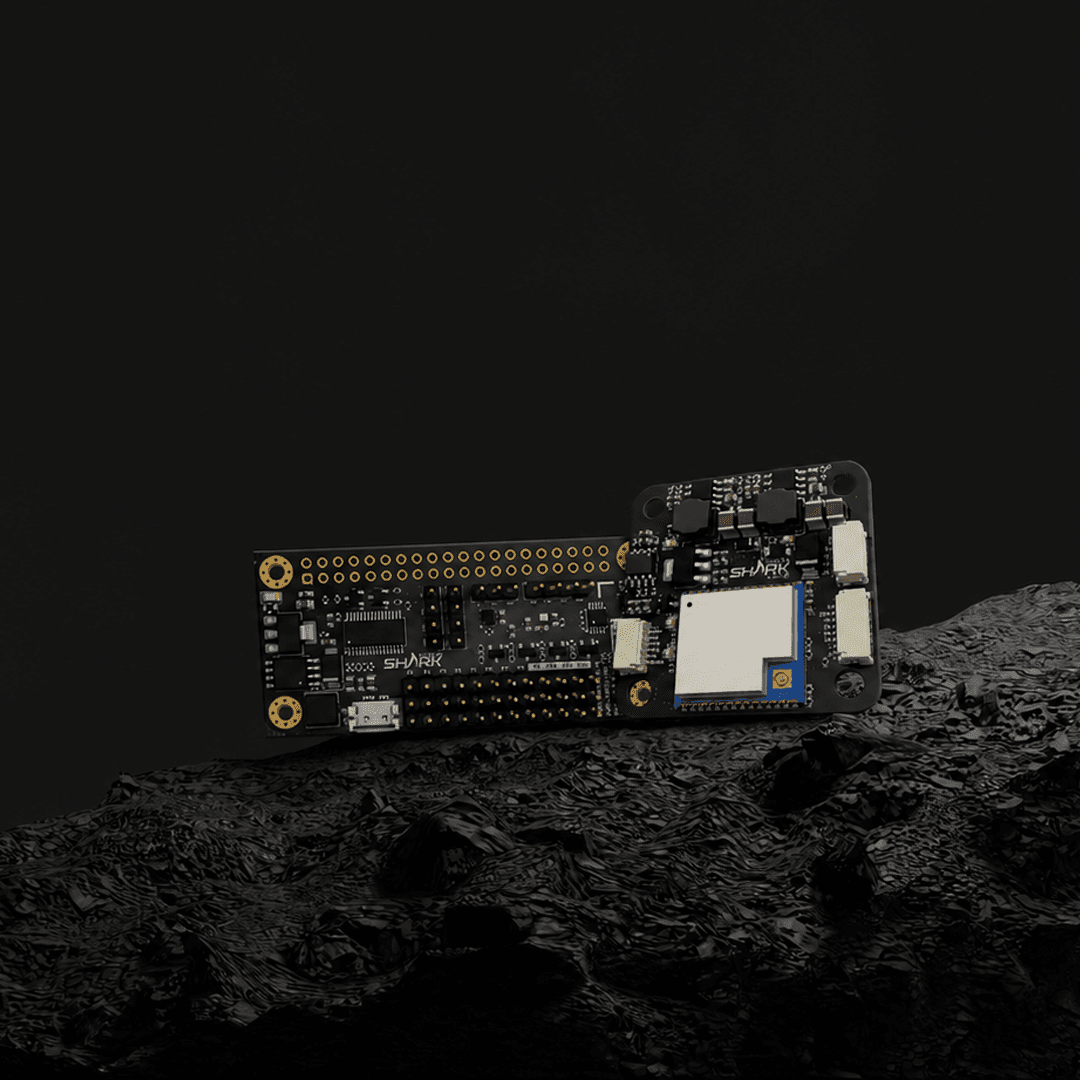
The Role of the Flight Controller
A flight controller is the brain of any unmanned aerial system. It processes sensor data, executes stabilisation algorithms, interprets pilot commands, and manages actuators — all in real time, with no tolerance for latency or error. Selecting or designing the right flight controller is one of the most consequential decisions in any UAS development programme.
At Shark Aviation Dynamics, we chose to develop our own flight control units rather than rely on commodity off-the-shelf hardware. This was not a decision we took lightly. The effort required to bring a custom FCU from concept to certified field deployment is substantial. But we believed that owning this layer of the stack would give us — and the operators who deploy our platforms — a meaningful advantage.
Two Units, One Series
The Shark Skyline FCU Series consists of two products designed to address different points on the capability spectrum.
Shark SkyBasic FCU
The SkyBasic is engineered for standard fixed-wing and multirotor installations where the priority is stable, predictable performance at a competitive weight and power budget. It supports all standard flight modes — manual, stabilised, altitude hold, and position hold — and integrates with conventional RC link protocols and common ground control systems.
Its architecture emphasises simplicity. Fewer software abstractions mean fewer failure modes. For operators running well-defined missions in familiar environments, the SkyBasic delivers exactly what is needed without unnecessary complexity.
Shark SkyNeuro FCU
The SkyNeuro is our answer to missions that demand more. It shares the same core processor family as the SkyBasic but adds a dedicated AI inference module that enables on-board processing of sensor fusion, adaptive control laws, and event-driven autonomy.
In practice, this means the SkyNeuro can adapt its flight characteristics in response to changing payload conditions, wind disturbances, or degraded sensor inputs — without requiring a ground operator to intervene. For long-range missions or operations in contested or GPS-degraded environments, this resilience is critical.
Hardware Architecture Principles
Both units are built around a set of shared hardware principles that reflect our engineering philosophy.
Redundant power rails. A single power supply failure should never bring down the flight controller. Both the SkyBasic and SkyNeuro route power through independent regulated rails with automatic failover.
Vibration isolation. Inertial measurement units are exquisitely sensitive to mechanical noise. We mount IMU clusters on dampened sub-boards, tuned to the vibration profiles of our own airframes — and documented for third-party integrators working with different platforms.
Thermal management. Aviation electronics operate across wide temperature ranges. Our thermal design accounts for both cold-soak conditions at altitude and sustained high-load operation in warm climates.
Field-Driven Development
One of the advantages of developing flight control hardware in-house is the feedback loop between our engineering team and the operators using our platforms in the field. Every firmware release incorporates observations from real deployments — not just data from simulation or bench testing.
This cycle is not glamorous, but it is how reliable hardware gets built. We plan to continue it as our platform and controller portfolios grow.
What Comes Next
We are currently working on the next revision of the SkyNeuro, which will include expanded support for multi-rotor configurations and tighter integration with the Shark GCS. We will share more details as development progresses.
If you are an integrator or operator with specific requirements for a flight control solution, we would welcome a technical conversation. Reach us through our contact page.